
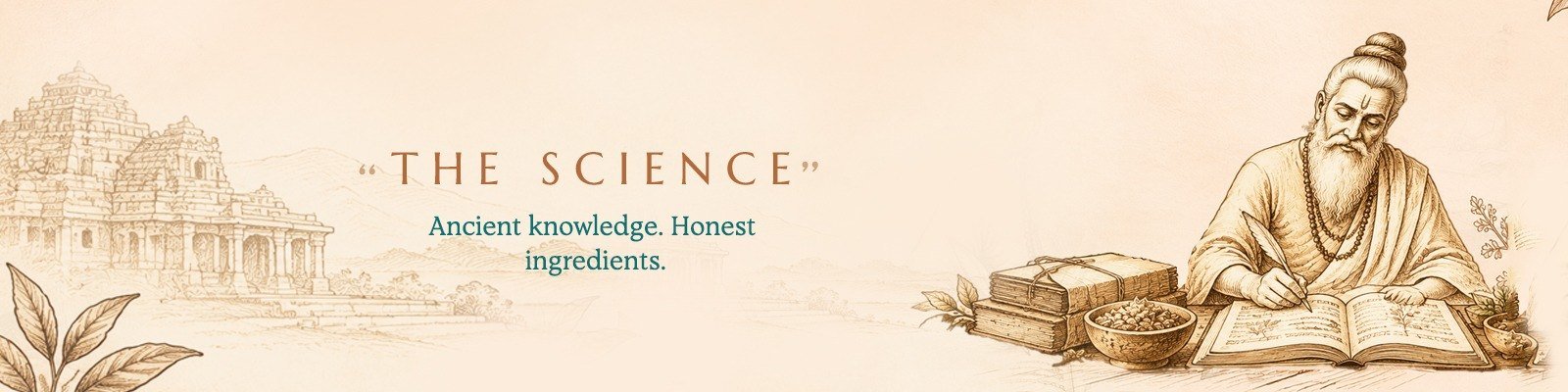
Our science is 2,000 years old. And it has never been wrong about herbs.
Patram Herbal is not a lab brand. We do not have certifications to show you. What we have is older, and in some ways more rigorous — the accumulated knowledge of India’s Ayurvedic scholars, recorded in texts that have guided natural healing for two millennia.
“सर्वं द्रव्यम् औषधीयम्।”Sarvaṃ dravyam auṣadhīyam. Everything in nature is medicine — for the one who knows. — Charaka Samhita
What We Mean by ScienceWe didn’t build our products in a lab. We built them in a library of texts that is 2,000 years old.
The word “science” has come to mean white coats, equipment and certificates on a wall. We understand why. Modern science has achieved extraordinary things, and we respect it.
But there is another kind of rigour — the kind that comes from thousands of years of observation, documentation and refinement by some of the most methodical minds in human history: the Ayurvedic scholars who wrote the Charaka Samhita, the Sushruta Samhita, and the texts that followed them.
These were not spiritual works alone. They were systematic medical texts. They named herbs. They described dosages. They explained mechanisms — what a plant does to the scalp, why an oil carrier matters, how combinations of herbs interact. They recorded what worked and what did not, across populations and across centuries.
That body of knowledge is our science. Not as a poetic metaphor — as a literal foundation. Every Patram Herbal formula begins in these texts. The ingredients we choose, the combinations we use, the methods we apply — all of it traces back to what Charaka and Sushruta documented with precision two millennia ago.
We are not the first people to trust this. Hundreds of millions of Indians trusted it for centuries before modern cosmetics existed. Arti trusted it when every modern product had failed her. And 800+ customers have found, as she did, that it continues to hold.
The Source TextsThey described what herbs do — with the same precision a modern paper would.
Consider what the Charaka Samhita wrote about hair, more than 2,000 years ago:
नित्यं स्नेहार्द्रशिरसः शिरःशूलं न जायते।
न खालित्यं न पालित्यं न केशाः प्रपतन्ति च॥
बलं शिरःकपालानां विशेषेणाभिवर्धते।
दृढमूलाश्च दीर्घाश्च कृष्णाः केशा भवन्ति च॥
Nityaṃ snehārdraśirasaḥ śiraḥśūlaṃ na jāyate | Na khālityaṃ na pālityaṃ na keśāḥ prapatanti ca || Balaṃ śiraḥkapālānāṃ viśeṣeṇābhivardhate | Dṛḍhamūlāśca dīrghāśca kṛṣṇāḥ keśā bhavanti ca ||
“One who keeps the head regularly moistened with oil shall not suffer from headache, baldness or greying. The hair becomes well-rooted, grows long, and retains its natural colour.”
Charaka Samhita, Sūtrasthāna 5/81–82 — c. 300 BCE
This is not a vague blessing. It is a specific, testable claim: that regular oiling of the scalp prevents hair fall, prevents premature greying and strengthens the hair at the root. It names the outcome. It describes the mechanism — nourishment at the root through oil application. It specifies regularity as the key variable.
Modern trichology has since confirmed many of these mechanisms: that oil-soluble compounds penetrate the hair shaft, that scalp massage improves blood circulation to the follicles, and that dryness and inflammation are leading contributors to hair fall.
The ancient scholars were not guessing. They were observing, recording and refining over generations.
इन्द्रियाणि प्रसीदन्ति सुत्वग्भवति चाननम्।
निद्रालाभः सुखं च स्यान्मूर्ध्नि तैलनिषेवणात्॥
Indriyāṇi prasīdanti sutvagbhavati cānanam | Nidrālābhaḥ sukhaṃ ca syānmūrdhni tailaniṣevaṇāt ||
“The senses become clear, the facial skin becomes smooth and glowing, and one gains restful sleep and happiness from the regular application of oil.”
Charaka Samhita, Sūtrasthāna 5/83
The Sushruta Samhita goes further — describing the seven layers of the skin (sapta tvak), the role of specific herbs in nourishing each layer, and the mechanisms by which natural botanical compounds support skin health and repair.
This is the level of specificity we work from. Not trends. Not marketing claims. Not ingredient lists assembled for aesthetics. Formulations built on observations that have been tested — across real people, across real conditions, across two thousand years.
How We Make ItHeat is the enemy of everything a herb contains.
When you heat a plant compound, you change it. Volatile oils evaporate. Polyphenols break down. Enzymes are destroyed. The compound that made a herb useful — the one the ancient texts identified precisely — is reduced or eliminated by the very process meant to extract it.
This is not a new discovery. The ancient Ayurvedic texts described cold and low-heat processing, specifically for herb-to-oil infusions, for exactly this reason. They understood that the potency of an ingredient lives in its intact compounds, and that protecting those compounds requires patience and low temperature, not speed and heat.
At Patram Herbal, all our herb-to-oil infusions are cold-processed or prepared at minimal heat. This means:
- The active compounds in each herb remain intact when they reach you
- The natural colour, aroma and texture of the ingredients are preserved
- No chemical stabilisers are needed to compensate for heat-damaged formulas
- What the Charaka Samhita described as beneficial is what actually reaches your scalp
Cold processing takes longer. Each batch requires more time and attention than heat-extracted alternatives. We consider this a feature of the product, not an inefficiency in the process.
“Sneha siddhir yathākālam — the perfection of oil comes through proper time and method.”
— Principle drawn from the Charaka Samhita processing guidelines
Every chemical we exclude has a reason. Here is the reasoning.
This is not a marketing position. Every ingredient we refuse to add is excluded because it either contradicts the natural formulation, masks a problem rather than solving it, or introduces a compound that the body does not need and the ancient texts never recommended.
| What we exclude | Why we exclude it |
|---|---|
| Mineral oil | A petroleum derivative that coats the hair shaft without nourishing it. Creates an illusion of shine while blocking the scalp from absorbing the botanical compounds that actually help. The samhitas prescribed plant-based oils specifically because they penetrate; mineral oil does not. |
| Parabens | Synthetic preservatives that extend shelf life at the cost of introducing compounds with documented hormonal disruption concerns. We do not need them, because we make in small batches and do not store products for extended periods. |
| SLS / SLES (sulphates) | Harsh synthetic detergents that strip the scalp of its natural sebum — the very oil your body produces to protect and nourish hair. Reetha (soapnut) cleanses effectively without stripping. SLS cleans dramatically and damages gradually. |
| Silicones | Create a temporary smoothing effect by coating the hair shaft. Over time they build up, make hair heavy, block moisture absorption and require harsh detergents to remove. A cycle of damage disguised as care. |
| Synthetic fragrances | A single “fragrance” listing can contain dozens of undisclosed synthetic chemicals. The natural aroma of our products comes from the herbs themselves. If it smells different from what you expect, that is because real herbs smell different from synthetic imitations of them. |
| Artificial colours | Our products are the colour of their ingredients. Bhringraj oil is dark. Beetroot face pack is pink-red. Neem oil is pale green. We do not alter this. The colour tells you something true about what is inside. |
| Chemical preservatives | BHA, BHT, formaldehyde-releasing preservatives — we exclude them all. Our preservation method is making fresh, in small batches, close to your order date. Freshness is the only preservation we believe in. |
Reading an ingredient list should not require a chemistry degree. Ours never will.
Our Preservation MethodFreshness is not a feature. It is the formula.
Natural compounds degrade over time. The polyphenols in Amla, the active terpenoids in Bhringraj, the sulphur compounds in Neem — all of them begin to lose potency from the moment they are processed. This is not a flaw in natural ingredients. It is simply how living compounds behave.
The modern cosmetics industry solves this problem with synthetic preservatives — chemicals that extend the usable life of a product from months to years. The compounds are kept alive artificially, at the cost of introducing substances that are themselves problematic.
Patram Herbal does not use this solution. We use a different one: we make fresh.
Every batch at Patram is made in small quantities. We do not manufacture large stock runs and store them in warehouses. We make when orders come, in amounts that match what is needed. What you receive has been made close to the date you ordered it.
- The active compounds are at or near their peak potency when they reach you
- No synthetic preservatives are needed or added
- Each batch is made with the same attention to quality, because no batch is scaled beyond what one pair of hands can give proper care to
- The product in your hands is genuinely fresh — not “fresh” as a marketing claim, but fresh as a verifiable fact about when it was made
The tradeoff: our products have shorter shelf lives than chemically preserved alternatives. We consider this a confirmation of quality, not a limitation. Something that lasts three years on a shelf without preservatives is either chemically preserved, or has very little active in it to begin with.
An Honest Answer““Nityam” — the Charaka Samhita’s word for the frequency of oil application — means daily, or regularly. The texts did not design for a product used once and stored for a year. They designed for a practice. Our small-batch model reflects this: made regularly, used regularly, replenished regularly.”
— On the word the texts chose
We don’t have a lab certificate. Here is why that is an honest thing to say.
Many brands in the natural beauty space display certifications prominently — ISO, GMP, USDA Organic and so on. These mean something in the right context. In the wrong context, they can become decoration on a product that is less natural than it claims.
Patram Herbal is a small brand. We are a homemaker from Gwalior who started making hair oil for her own use, and a growing community of 800+ people who found out about it by word of mouth. We are not yet at a scale where formal certification is something we have pursued.
What we are is honest about that. Here is what we can tell you instead:
- Every ingredient we use is something you can identify by name — a plant, an oil, an earth, a root
- Arti makes every batch personally in her own kitchen. There is no anonymous manufacturing chain
- We have 400+ repeat customers who order again and again without any marketing pressure. They come back because the product works for them
- We invite you to read our ingredient lists in full. If any ingredient requires explanation, we will give it. If any ingredient raises a question for you, we want to hear it
We are building toward formal certification as we grow. Until then, our transparency is our credential.
The ancient texts we work from have a word for this quality of honesty in practice: Satya (सत्य) — truth as a discipline, not merely a declaration. We hold ourselves to it.
The Herbs and What They Do“We would rather you read our ingredient list and trust what you see than read our certifications and trust what they imply.”
— Arti Yadav, founder
Each ingredient has a mechanism. The texts described it. The results confirmed it.
Here is how the key herbs in Patram products were understood by the ancient texts — and what they do in the products we make.
| Herb | What the texts said | What it does in our products |
|---|---|---|
| Bhringraj भृंगराज | The Charaka Samhita names it Kesharaja — king of hair herbs. Prescribed for hair fall, premature greying and scalp disorders. | The primary active in our 13+ herb Hair Oil. Stimulates hair follicles, slows follicle miniaturisation and supports melanin production in the hair shaft. |
| Amla आँवला | Described across the Charaka Samhita and Sushruta Samhita as Dhatrifal — a supreme Rasayana, or rejuvenating agent. Specifically recommended for hair strength, lustre and prevention of greying. | Used in our Hair Oil, Shampoo and Hair Pack. Exceptionally high in vitamin C and tannins — strengthens the hair shaft, improves elasticity and adds natural shine. |
| Brahmi ब्राह्मी | Prescribed in the samhitas as a nervine tonic with direct effects on scalp circulation and hair root nourishment. | Present in the Hair Oil. Improves blood flow to the scalp, reduces stress-related hair fall and nourishes hair follicles at the root level. |
| Reetha रीठा | The Charaka Samhita lists it as a natural cleansing agent — Shirovirochana — specifically for scalp and hair. | The cleansing base of our Shampoo. Saponins in Reetha create a natural lather that lifts dirt and excess oil without stripping the scalp’s natural sebum. |
| Hibiscus जवाकुसुम | Referenced in classical Ayurvedic texts as Japapushpa — a conditioning and strengthening herb for hair. | Used in our Shampoo and Hair Pack. Rich in amino acids and vitamin C — reduces breakage, improves texture and adds natural conditioning. |
| Neem नीम | The Sushruta Samhita prescribes neem extensively for scalp disorders — dandruff, inflammation, fungal conditions and scalp infections. | The active in our Neem Hair Oil. Antibacterial, antifungal and anti-inflammatory — addresses the root cause of dandruff and scalp irritation rather than masking symptoms. |
| Multani Mitti मुल्तानी मिट्टी | Fuller’s Earth — referenced in classical texts as an earth-based purifying agent for the skin, drawing toxins and impurities from the surface. | The base of our Face Pack. Absorbs excess oil, unclogs pores, soothes inflamed skin and leaves a natural matte finish without synthetic additives. |
| Beetroot चुकन्दर | A potent natural source of betalains — pigments with antioxidant and anti-inflammatory properties documented in classical and folk Indian healing traditions. | The signature ingredient of our Beetroot Face Pack. Provides a natural glow through antioxidant activity, while the natural pigment visibly brightens the complexion. |
This is not a complete list. Every ingredient in every Patram product has a name, a source and a reason. We will tell you any of it, any time. Ask us.
Knowledge this old deserves ingredients this honest.
Every product we make is a direct application of what the ancient texts described — made by hand, made fresh, made without compromise.
Shop the RangeRead the IngredientsAsk Us Anything
नित्यमभ्यङ्गमाचरेत् स जरां न च माल्यति।Nityamabhyaṅgamācaret sa jarāṃ na ca mālyati. “One who practises oil application daily shall not be touched by age.” — Charaka Samhita